
The kids aren’t alright
they care too much about their looks

There is a prevailing opinion that childhood is not lasting as long as it used to and the internet is responsible for accelerating the journey. Not to adulthood per se but to wanting to be ‘grown up’.
As a teacher, never is that adult aspiration more clear than when with a Year 6 class. It is the year where sensitive conversations about deodorant take place. The year where the girls tower over the boys. The year before they all become small fish in a big pond full of hormones. They are ready to, by and large, make that jump. Yes, some of them still love their superhero lunchboxes and believe in the magic of Christmas but others swear and make inappropriate gestures when they think you cannot see them. And do not assume that the two mindsets are mutually exclusive either. But that is all very normal. Learning curse words is a rite of passage as much as getting your first payment from the tooth fairy.1
It is the creeping obsession with aesthetics that worries me. The idea that looking good is your main currency. It’s a notion that is hard to avoid in a society, and arguably an economy, that is increasingly image-led.
I sometimes let myself have cheat days.
I heard those words at a school in a small town in the county I live in. But not in the staffroom or in the office for they were uttered in the classroom. And not by a teaching assistant making idle chitchat but by a student. A student who was ten or eleven years old. She had the overall appearance of someone who was too keen to grow up and look a certain way. To skip the SATs and the braces and the awkwardness of it all. And, that’s fine… I guess?
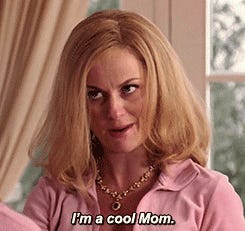
But those words that she uttered. They are not fine. Far from it. The concept of a cheat day is quite bleak when it rolls off an adult tongue but truly hellish when it emanates from a school desk. How did we get to this point? I reported it to full-time staff who were saddened but unsurprised. The way they described the girl’s mother gave me visions of Amy Poehler in Mean Girls if she was an almond mum. The school were monitoring the girl at least.
It should not have shocked me too much though. Thinness seems to be in vogue once more. There were plenty of articles last year about #skinnytok and the way in which it was directing TikTok users towards harmful content. In a similar vein the excellent Lily O’Farrell, the woman behind the fantastic No Worries If Not! podcast, recently put out an episode about the link between thinness and the ideal right-wing woman. There was also a lot of discourse surrounding the bodies of Ariana Grande and Cynthia Erivo during the Wicked press tour. The difference between now and the nothing tastes as good as skinny feels era is that the prevalence of online communities (and their ‘resources’) normalises that particular body type. In the same way that fascists are emboldened by finding like-minded single-cell organisms online, girls and women aiming for skinny have their goal reinforced by others.
The beauty industry is playing its part too. There are skincare ranges, often associated with a celebrity, being aimed squarely at children. It stems from social media and is yet another issue that can be laid at the feet of our problematic tech overlords.
It is not confined to the girls either. The boys often tease each other about their hairlines (immediate detention if they even look my way) which is profoundly depressing. One boy traced his jawline with a felt tip to prove a point to a friend. Thankfully there were no hammers in the classroom for them to use.
This is not intended to be an alarmist piece, just a snapshot of what I have seen. There are many children who, for now, seem unaffected by nefarious influences. They are funny and smart. But online culture, in its current iteration, is having an undeniable impact.
1 If you thought inflation on a Freddo was bad…